TRANSFORM: Where Your Inner Shift Becomes Outer Impact


This is the fifth article in a series introducing SOFT Leadership. If you missed the previous ones, start here: What is SOFT Leadership?
There is a moment in leadership — and if you have been in it long enough you will recognise it — where something quietly changes. Not because of a new strategy or a restructure or a particularly good quarter. But because you changed. Because the way you were showing up shifted, and everything around you began to reorganise in response. That is Transform.
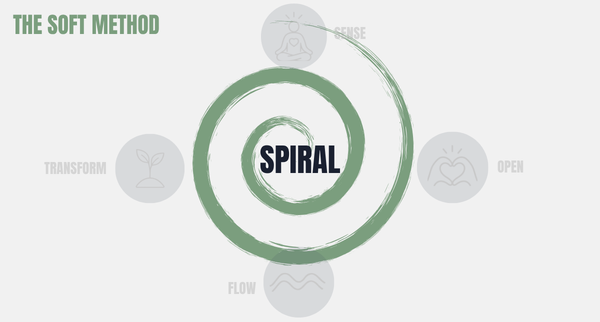
It is the fourth phase of SOFT Leadership. And it is the one that moves leadership from a personal practice into something collective. Something that ripples.
What Transform actually means
Transform is not a dramatic reinvention. It does not arrive as a lightning bolt. It is the accumulation of everything that came before it.
When you have practised Sense long enough to trust your own signals. When you have built enough Open into your leadership to be genuinely present rather than just available. When Flow has taught you to move from alignment rather than obligation. At some point, the way you lead starts to look different. Not because you decided to change it. Because you already did, in the small decisions, the pauses, the honest nos and the full-presence yeses.
Transform is where that inner work becomes visible. Where the shift in you creates a shift in the people around you.
This is the phase that makes SOFT Leadership more than a self-improvement practice. It is where it becomes a leadership philosophy with real organisational impact.
What shifts when you do
I have watched this happen in teams I have led, and I have felt it happen in myself. There is a particular moment when a leader stops performing certainty and starts embodying clarity. When they stop managing people and start genuinely seeing them. When they stop measuring success by output alone and start asking what their team is becoming in the process. That shift does not go unnoticed.
When you lead from genuine awareness, people feel safe enough to bring their real ideas rather than their safe ones. When you model rest and boundaries, you give your team permission to have needs too. When you make decisions from alignment rather than urgency, the quality of everything downstream improves.
Your inner state is not private. It transmits. And what it transmits shapes the culture you are building, whether you are conscious of it or not.
I used to think culture was something you created through policies, mission and vision statements. The positive words plastered on the walls or in company decks. During company dinners, and team gatherings. It is felt before it is seen. It is pervasive and permeates through every fibre of team culture. Both the good and the bad. It is built not in the big moments, but in the thousands of small ones. What I understand now is that culture is the energetic residue of how a leader shows up every day. Once a culture is set, its very hard to change. The good news is, it’s possible, but takes time and patience.
Transform is not about perfection
This is important to say, because Transform can sound like an arrival point. A place you reach when you have finally got it right. It is not that.
Transform is a direction, not a destination. It is the ongoing practice of leading from a place that is more honest, more present, more aligned than the day before. Some days that looks like a difficult conversation handled with care. Some days it looks like admitting you do not have the answer and trusting your team to help find it. Some days it looks like choosing rest over the next thing on the list, even when the pressure says otherwise. It’s staying calm when things are not going to plan. It’s how you receive new people into the company, and how you treat people when they leave.
None of those moments are dramatic. But all of them are transformative. In you, and in the culture you are shaping.
The question Transform asks
Most leadership frameworks ask: what are we achieving? Transform asks something different: who are we becoming in the process?
Not instead of results. Alongside them. Because a team that burns out to hit a target has not succeeded in any meaningful sense. And a leader who achieves their goals at the cost of their own integrity, health, or humanity (and of their team) has not led well, regardless of what the numbers say.
When you start asking who we are becoming, something shifts in how you make decisions, how you hold your team, how you define what a good year looks like. The metrics do not disappear. But they sit alongside something more human. Something that accounts for the whole of the experience, not just the output.
If you hit all your targets, but everyone (yourself included) is miserable, then have you really succeeded? Is life just about the numbers we achieve? Or also about the journey in which we got there?
Where to start
Reflect on one decision you made this week. Not whether it was the right strategic call, but who you were when you made it. Were you present or depleted? Acting from clarity or urgency? Leading from your centre or from fear of what would happen if you didn't?
That reflection, practised consistently, is where Transform begins.
Because business is human. And the future of leadership is SOFT.
Next in this series: The Spiral — why this is not a four-step process.


Comments